
Looking Deeply: Rage, Love and Solidarity

I sit with what is happening in South Africa with the xenophobia, and with what has happened to Professor Jason Arday. And the word I keep returning to is rage.
Not only grief. Rage.
Rage at the brutality with which institutions can elevate a Black person, hold them up as evidence of their own progress, and then participate in — or fail to protect them from — their public dismantling. His family has spoken of a sustained campaign of abuse and harassment, while questions continue to be asked about the role of the media and the support offered by the university.
Part of what makes this form of racism so difficult to name is that it can present itself as scrutiny, fairness or legitimate questioning. Beneath it can sit a deeper disbelief: can this Black person really have earned this authority, recognition or place? The language may be neutral while the intensity, assumptions and consequences are not.
But my rage is not only directed at Cambridge, or the press, or Britain.
It is also directed at what these systems do between us.
They divide us. They flatten profoundly different histories and experiences into convenient categories. They decide whose Blackness is intelligible, whose suffering counts, who is respectable, who is troublesome, who gets proximity to power and who can be discarded.
And they can divide those who are already marginalised from one another too.
Some voices become more legible to institutions while others remain inconvenient. Some forms of difference are welcomed while others disturb the existing order. We can find ourselves competing for recognition, legitimacy, safety and access. We can align ourselves with establishments because proximity offers some protection or benefit.
Sometimes we remain silent while another person is being torn apart.
Sometimes we help with the tearing.
There is a particular violence in being made to carry the projections of racist propagandists, institutions protecting themselves, people joining the spectacle, strangers feeding an algorithm — and sometimes, painfully, people we imagined were our friends.
What happens when a human being becomes the place where a collective puts what it cannot bear to examine in itself?
What is happening in South Africa makes this feel even more visceral for me. I am watching xenophobia once again turn people with shared histories of colonialism, extraction and racialisation against one another. African against African. People facing insecurity persuaded that someone with even less security is the threat.
The poverty and inequality people are living with did not appear from nowhere. They have histories — colonial extraction, dispossession, borders drawn for empire, wealth continuing to move outward. Yet the anger these conditions generate so often lands not on the systems that produced them, but on the neighbour, the migrant, the person with less power.
And I keep seeing the same thing: pain created by systems gets turned against people.
A Black person celebrated as proof of progress can become expendable when they are perceived as challenging the established order. In communities, too, the person who names what is wrong can become the problem.
We make people carry the patterns of harm we are unwilling to disturb.
And this is not confined to academia or South Africa.
I have encountered versions of it in interfaith spaces and, painfully, in Sangha and spiritual communities. I know something of this dynamic myself.
No Sangha exists outside the society in which it practises. We bring into our communities the same seeds of racism, patriarchy, class, hierarchy, scarcity, competition and fear that exist in the wider world. Buddhist practice gives us ways to recognise and transform these seeds; it does not make us immune from them.
Places that speak beautifully about compassion, justice, inclusion and solidarity can still reproduce the very patterns they hope to transform.
At very short notice this week, I gathered a space for Black and other people of colour to sit with some of what had been stirred — grief, rage, bewilderment, whatever was present. We stayed together for hours.
What became clear was that people were carrying much more than Professor Arday’s story alone.
There are times when we need spaces where rage does not first have to be explained, softened or translated in order to be received. But I also found myself wondering what it would take for our wider Sanghas and communities to hear such rage deeply — not to calm it down or spiritually transcend it, but to understand what it is telling us, repair what has been harmed, and ask what needs to change in our communities and in the wider society, because none of us is liberated alone.
It can be easier to grieve racism when its consequences are visible somewhere else. Harder is what we are willing to see closer to home.
I have also been wondering about the grief expressed publicly by those who had power, proximity or influence while the harm was unfolding. Grief may be sincere, but if there was silence when action was still possible, what does that grief ask of us now?
I keep returning to words by Omar El Akkad:
“One day, when it’s safe, when there’s no personal downside to calling a thing what it is, when it’s too late to hold anyone accountable, everyone will have always been against this.”
There is something painfully recognisable in that.
Grief afterwards cannot repair what has happened. If nothing is acknowledged or changed, the conditions remain, and the harm can happen again.
Our practice asks whether we can see clearly enough to act before it is too late.
Our grief for Professor Arday, however sincere, cannot be the end of the practice. It must also turn our attention towards our own structures, Sanghas and relationships. Where do we exclude, marginalise, or make belonging harder? Where do we protect reputation or relationships over people? Where do we minimise harm, or leave someone to carry alone what the community does not want to face?
For me, this also means looking honestly at my own relationship to belonging and power.
It means noticing when belonging asks me to stay silent, when proximity to power becomes more important than solidarity, or when I find myself competing with other people of colour for the limited places made available to us.
Simply having a seat at the table does not make the table just. I have to ask what I am protecting by staying there, who is still outside, and whether keeping my own place has become more important than changing what is wrong.
Perhaps this is one of the harder questions inclusion asks of our Sanghas and communities.
Not only: Who have we invited in?
But: What happens once people are here?
Who becomes difficult for us to hold? Whose pain becomes inconvenient? Who is protected when conflict arises? Who has to adapt themselves in order to remain acceptable?
And perhaps the harder question still:
Have there been moments when our own communities have allowed one person to carry what actually belonged to the collective?
Sometimes a community preserves its image of harmony, or protects relationships and reputations, by allowing the person naming harm to become the problem. Sometimes our own desire to belong makes silence seem safer while somebody else is moved towards the edge or marginalised.
And we may still call ourselves inclusive while this is happening — even while those causing or enabling the harm remain protected or rewarded.
Our Sanghas are imperfect. They are human communities; we carry conditioning and can cause harm. But imperfection cannot become an excuse for refusing to look deeply and change what allowed the harm to happen.
Without acknowledgement and repair, harm does not disappear. It stays with a community, even when we continue to think of ourselves as compassionate and inclusive.
This is why what happened around Professor Arday feels larger than one man or one university. It raises questions about collective protection, about what we may overlook in order to belong, and about whether our communities can uphold one another without requiring somebody else to remain at the edge.
And I keep wondering what deep looking asks of us here.
Solidarity does not require us to pretend that we all love one another, or that there is only one correct way to belong. But surely it asks that we treat one another with dignity; that we do not secure our own belonging through somebody else’s exclusion; that we do not look away when someone is being harmed; and that we are willing to examine what our own communities may be reproducing.
Expressions of grief, care and love matter. But they are not the same as solidarity. Solidarity asks something of us while there may still be a cost to standing beside someone.
We use the word love so easily. We speak of compassion, beloved community, interbeing.
But love without solidarity is sentiment.
Love that does not interrupt the public destruction of another human being is not enough.
Love that protects our own access to power while somebody beside us is being sacrificed is not enough.
Love that asks the wounded person to be more understanding, more equanimous, more forgiving, while leaving the structure that wounded them untouched is not enough.
The Buddhist commitment to non-harming asks more of us than whether we personally struck the blow. It asks whether we saw what was gathering around another person, whether we added to it or remained silent, and whether we were willing to stand beside them and help repair what had been harmed.
Perhaps solidarity begins somewhere much harder: in refusing to secure our own peace, safety or belonging at somebody else’s expense.
Refusing to make another human being the price of our admission.
And learning, somehow, to stand together before another life has been broken.
Deep looking begins, perhaps, with seeing the human being before reducing them to the story being told about them.
So I am asking myself, and I am asking us: where, in our own Sangha, our own family, our own institution, is someone quietly being asked to carry what belongs to all of us? And what would it take — not later, after the harm is done, but now — to stand beside them instead?
Because my rage is not the opposite of love.
Right now, it may be the form love takes when it refuses to look away.
About the author
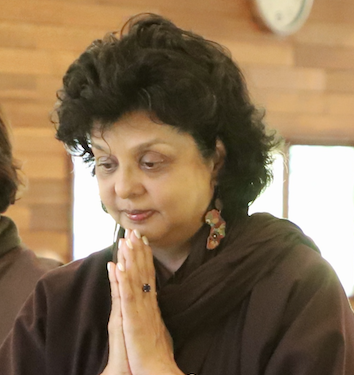
rehena Harilall is a lay Dharma teacher in the Plum Village tradition, with a longstanding commitment to engaged Buddhism, racial justice and interfaith work. Her writing and teaching explore belonging, power, solidarity and the practice of compassion in a world shaped by inequality and conflict.